
Every week, women come to FitLabPro with some version of the same sentence: “I’m doing everything I used to do, and nothing works anymore.” They’re not wrong, and they’re not broken — their body’s operating system has changed, and the old workout-and-diet playbook needs an update to match it.
This isn’t a generic rundown of things you’ve probably already read on ten other fitness blogs. This is how we actually structure the Foundation, Balance, and Progress programs at FitLabPro for women over 40 — and why.
If you’ve noticed that your old diet and exercise tricks aren’t working like they used to, you aren’t alone. Your body is changing its “operating system,” and it’s time to update your lifestyle software to match.
Most women start perimenopause in their early-to-mid 40s, and estrogen and progesterone begin fluctuating well before periods stop. Three things follow from that, and they’re the reason “just eat less and walk more” stops working:
None of this means your body is failing you. It means it needs a different kind of training input than it did a decade ago.
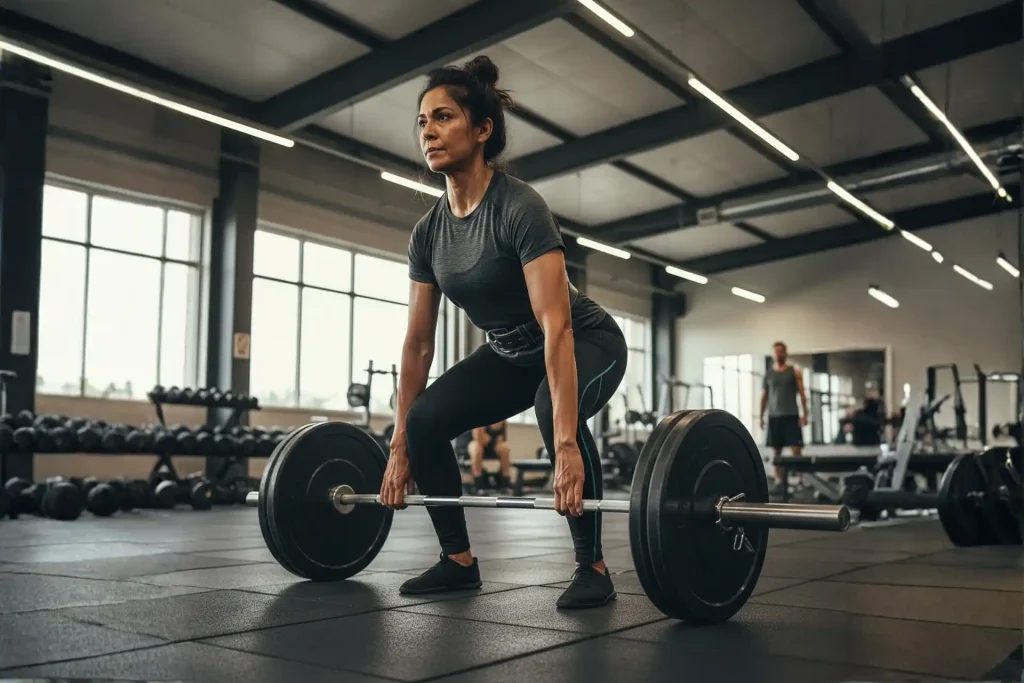
In our coaching plans, the order of priority is strength first, cardio second — the reverse of what most women were taught in their 20s and 30s.
Strength training is the non-negotiable. Every FitLabPro plan, from Foundation upward, is built around resistance work two or more times a week, because lifting is what protects bone density as estrogen declines, raises your resting metabolic rate, and rebuilds the muscle mass that’s slipping away with sarcopenia. Clients often expect this to be the “hard” part of the program; in practice, it’s usually the part that produces visible results fastest.
Cardio gets reprioritized, not eliminated. Long steady-state cardio sessions can raise cortisol enough to encourage the body to hold onto belly fat — which is often exactly the opposite of what someone doing an hour on the treadmill is hoping for. We coach two cardio modes instead:
The nutrition guidance we give inside our programs centers on stabilizing blood sugar rather than cutting calories aggressively, because chronic under-eating tends to backfire on a system that’s already under hormonal stress.
Protein at every meal. We coach clients toward roughly 25–30g of protein per meal — from sources like lean chicken, eggs, Greek yogurt, dals and lentils, and fish where available — partly because protein has a high thermic effect, and partly because it’s the main defense against ongoing muscle loss.
Fiber for hormone clearance. Fiber helps the body clear out metabolized estrogen rather than reabsorbing it. We aim clients toward 25–30g daily from sources that are easy to build into an Indian kitchen — foods like whole moong, chia seeds, guava, and leafy greens such as methi and palak, alongside the more commonly cited raspberries and broccoli.
No “naked carbs.” A carb eaten alone spikes blood sugar faster than the same carb eaten with fat or protein alongside it. Practically, that’s the difference between plain poha and poha with a side of curd and peanuts.
We treat sleep and stress management as training variables, not lifestyle add-ons, because the physiology backs that up: poor sleep raises ghrelin (hunger) and suppresses leptin (fullness), which can undo a week of consistent eating in a couple of bad nights. High stress raises cortisol, and cortisol specifically promotes visceral fat storage around the organs — the kind that’s hardest to shift with exercise alone.
That’s why the Balance and Progress plans build in short daily down-regulation practices — 10 minutes of breathwork or a wind-down routine — alongside the training and nutrition guidance, rather than leaving recovery entirely up to the client to figure out.
The women who see the most durable results after 40 aren’t the ones chasing the number on the scale — they’re the ones who shift the goal to body composition: more muscle, better insulin sensitivity, steadier energy, and sleep that actually restores them. That shift in mindset, more than any single workout or meal plan, is what our coaching is built around.
Curious which plan fits where you’re starting from? Explore FitLabPro’s Foundation, Balance, and Progress Plans →
Fitness writer at FitLabPro focused on strength training and hormonal health for women in their 40s and beyond, translating evidence-based coaching principles into practical, everyday guidance.

Cultivate Calm & Unleash Your Strength: Join Our Women’s Fitness Community.

